This is a copy of a short paper I delivered at Figments: Madness, Health and Creativity, a conference hosted by the School of Critical Studies at the University of Glasgow in partnership with the Centre for Mad Culture UK, on 15 June 2026.
I want to offer my heartfelt thanks to everyone who was a part of the Inner Worlds community in any way, and especially to the people who shared their thoughts with me through the online survey, and whose answers form the basis of the paper.
When I was eleven, for a brief time I thought I was a robot. Or I thought I might be, I wasn’t sure. It was the best explanation I could come up with as to why I didn’t seem to have feelings any more.
I was concerned, of course, about the implications. But I also remember a sense of relief at having found a way to understand what was happening to me. It was an idea I could get a hold of, it was an idea I could explore. In a way it was comforting, even exciting. That year I had fallen in love with science fiction, and I was inhaling books by Isaac Asimov, Ray Bradbury, Douglas Adams, and more. Those stories became a lifeline, but I think the greatest gift they gave me was that idea.
Quite soon really the belief went away, but the idea stayed with me. It gave me words and images to identify what happened and how it felt and to make sense of my experiences before I ever heard words like ‘depersonalisation’ or ‘dissociation’ or 'trauma'. And it has given me a way to communicate those experiences to other people more truly and more vividly than any clinical terms can offer.
Later, in therapy I found myself reaching for more ideas and images from speculative fiction – whether sci-fi, fantasy, or horror. They were the best tools I had to understand and describe how things were for me. Happily my therapist rolled with it, and would eventually know what I meant when I talked about “black hole feelings” or said that I felt like “a haunted suit of armour”.
Some of these ideas and images became stories and poems; a sinkhole in the heart, a time travel bureau exploiting PTSD flashbacks, various hauntings. They were hard to write, but they helped me a great deal. As I wrote, I also read, encountering the work of contemporary authors engaged in a similar project including Seanan McGuire, Tananarive Due, John Wiswell, Sarah Gailey, Joe Koch, Martha Wells, Becky Chambers, P. Djèlí Clark, and so many more. (I won’t list all their literary ancestors too – but I will add that if you haven’t yet read Beloved by Toni Morrison it’s time to get on with that.)
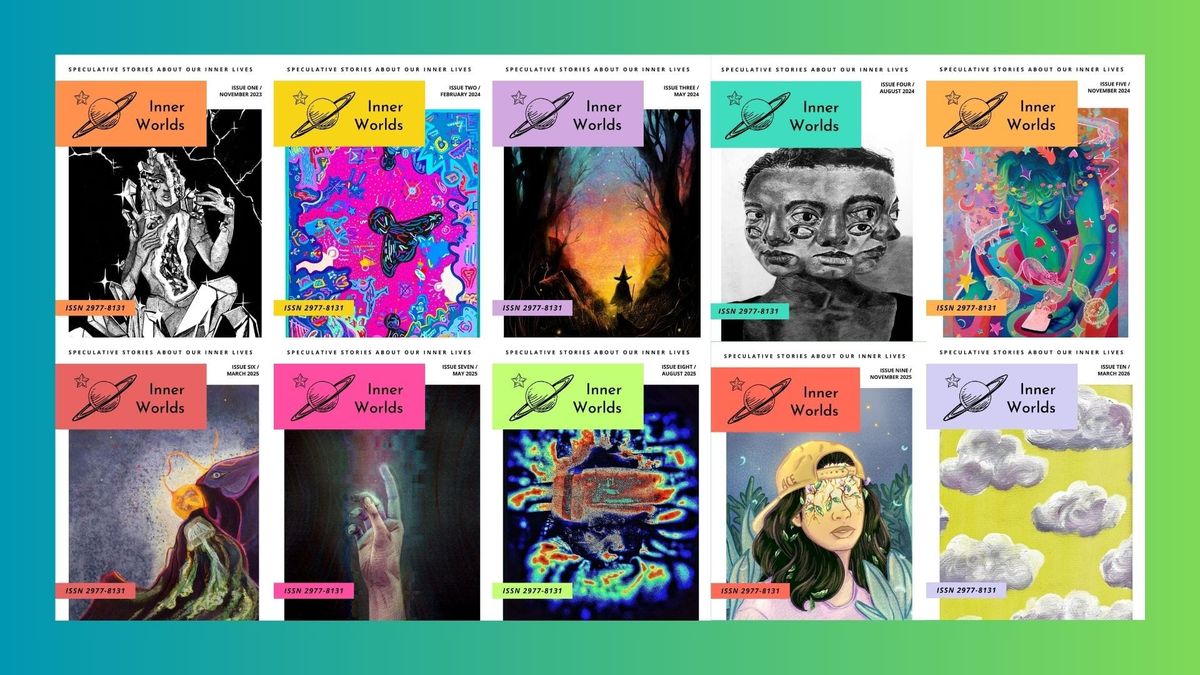
This is a long-winded way to explain what Inner Worlds was and why I made it. Inner Worlds was a digital magazine of speculative stories about our inner lives, founded in 2023 and closed at the start of this year. There were 10 issues, featuring 120 stories in total, in which authors explored all kinds of internal phenomena using tropes, images, settings, and ideas from fantasy, science fiction, and horror. I tried to run it as fairly and ethically as possible; authors kept full control over their work, everybody got paid, and we succeeded to a large extent in our aim to uplift marginalised voices. We built a small but awesome community of writers, readers, artists, subscribers, and supporters, and I was touched that just last week one of the authors we published was posting about how they miss us. I miss them too.
Although the magazine was deliberately a broad church, and lots of stories are about thoughts and feelings that aren’t typically pathologised (such as grief, guilt, or love) many authors named their personal experience of neurodivergence, psychological and emotional distress, madness, and altered states. Stories explore anxiety, depression, trauma, voice hearing, suicidality, obsession, postpartum psychosis, plurality, and dissociation, alongside countless other experiences.
As the editor I read each of the 3,000+ short stories that were submitted to the magazine over the three years it was open, and in that time I only became more fascinated by the potential of speculative fiction to explore and express these subjects, and more awed by the sheer dazzling range of images and ideas that people came up with.
Trying to choose some examples to share with you has been incredibly hard, for this reason! The diversity is the point. So I will just mention a few that were highlighted by my survey respondents as being especially meaningful for them. “Things Elan Reacquainted Himself With After Breaking Out of His Single-Day Time Loop” by D. A. Straith tells a bittersweet story about past trauma, portals, and new beginnings in the form of a list. In the horror story “Flash/Flash/Flash” by C. J. Subko, intrusive images slowly shred the protagonist’s reality to ribbons. “New Immortals” by Lex Chamberlin asks if spending forever in a body that doesn’t feel right is too high a price for immortality. And finally “What to Do When A Demon is Talking Shit at You” by Cindy Phan offers practical tips and a reminder that, in the author’s words, “when the cruelty is the point, then rage is the answer”.
Earlier this year, I asked the Inner Worlds community if they found reading or writing speculative fiction specifically helpful for their wellbeing, and how speculative fiction compares to realistic fiction or non fiction as a way to explore themes around mental health or madness. Several themes emerged from the 18 survey responses I received. I’ll illustrate them as far as possible in the respondents’ own words, which they have kindly given me permission to share.
The first and most frequently mentioned was that science fiction, fantasy, and horror offers distance, detachment, or containment that allows people to examine intense or overwhelming experiences. “Some things are incredibly hard to talk about, even to think about. Speculative fiction makes it easier to explore mental health themes, at least to me,” wrote one respondent, adding “It lets us look at the monster through a mirrored shield”, invoking the myth of how Perseus escaped being frozen by the gorgon’s gaze. Others wrote about the same effect: “as a reader, it lets me look at my own problems from the side, when I am unwilling to face them directly”.
Several answers on this theme of useful distance used the imagery of looking indirectly, from a different angle, with a different focus, or through a reflection or filtered perspective. For example, someone said that they enjoy speculative fiction because it allows them “to engage with emotionally or intellectually difficult ideas through an unreal lens”. Another respondent said “it was very freeing” to be able to examine some complicated feelings “through the fantasy lens”. I like this notion of the fantastic, the horrific, or the futuristic as protective eyewear. I wonder if the lenses also reveal things, like the sunglasses in the 1988 John Carpenter film They Live which allow the protagonist to see subliminal messages and identify disguised aliens.
While one function of this speculative container is protective, another seems to be more about a slowing down or opening up which enables experiences to be processed more fully. “The fact that I can use an unreal world to explore real world problems allows myself a certain emotional detachment in the moment,” one respondent wrote. “Later I realise I have really worked through some problems almost without noticing.” Someone else wrote about how fantastic or supernatural settings give them “power to influence events that normally I would not have”, and shared that through this they have been able to deal with some issues around anger. As writers we have the opportunity to level the playing field.
The next distinct theme I noticed in the survey answers is that working with metaphor or analogy in speculative genres enabled people to extend and explore ideas and experiences in their full depth and complexity. As one respondent put it: “It allows metaphors to become literal, and hence much more fully explored. ‘It can sometimes feel like I am two different people’ can become a story about two actually separate entities, allowing exploration of just how they would interact and behave”.
This opportunity for deeper exploration can be fruitful for both writer and reader. One respondent wrote: “These metaphors allow me to see and understand parts of myself and parts of other people in a different way. Sometimes it makes complex ideas easier to understand. Sometimes it puts words to experiences and feelings that are otherwise difficult to express. Sometimes it allows me to understand and empathize with others in ways I never would have before.” I'll come back to this point about empathy.
Another survey respondent welcomed the opportunity to bring attention to difficult subjects without confronting readers with them directly in a realistic mode: “Sometimes it's easier to slide complex Truths into a reader's awareness through the allegory or analogy that speculative fiction can provide.” More than one person who answered the survey quoted Emily Dickinson’s advice to “tell all the truth, but tell it slant”.
These ideas relate closely to the next major theme I found in the survey responses, that the expansive realities offered by speculative fiction allow authors to be more honest and more accurate when describing their experiences. To tell all the truth. This feels like the absolute heart of it for me, and I thought this survey response put it well: “It is very hard to explain in realistic ways what it feels like to experience mental health situations (positive or negative). There needs to be a poetry there that realistic fiction just can't get at.” Another emphasised the way that writing these experiences can render them legible for the writer as well as the reader: “Spec fic allows me to say things that most people can't understand otherwise, and allows me to understand things I would otherwise not quite comprehend”.
For me, the extraordinary possibilities of science fiction, fantasy, and horror alone feel large enough to hold the totality of my experiences; the good, the bad, the strange, the mundane, the familiar and confusing. Horror in particular appeals to me because it’s impossible to be ‘too much’ in a horror story: excess and intensity are highly prized. These genres can handle me. They allow me to “be more real” in the words of one survey respondent.
Speculative fiction about madness, altered states, and psycho-emotional distress offers an valuable corpus for phenomenological analysis precisely because, as one respondent put it, “the main difference between realistic and speculative fiction is that realism depicts what happened, whereas the speculative depicts what it was like”. This is the dimension which interests me the most, because it’s “what it was like” which builds empathy and forges the connections between us. One survey respondent reflected on their experience that “mental health issues as portrayed in realistic fiction are done in a voyeuristic manner, like these characters are in a circus and the readers aren't invited to empathize, but to gawk instead”. They felt that these stories can offer an alternative.
The final theme I wanted to highlight is easy to overlook but I feel it’s equally important, especially in our current cultural and political moment. Why write speculative fiction? Why read speculative fiction? Because it’s fun. Several survey answers made it clear that reading and writing fiction set in other worlds offers restorative escapism, inspiration, and pleasure. Restorative is key; respondents made it clear that escapism helped them to recharge, not run away: “It's escapist and exciting and lets me take a break from the real world long enough to catch my breath.” Another wrote, stirringly: “Speculative fiction is hope when the madness around me has stolen my control. When my reality refuses to solve the problems I face, the sci-fi stories I write do. Sci-fi is the sword of optimism against the despair of human darkness.”
The appeal of the invitation or challenge to “imagine bigger” was mentioned in several survey answers. For example, one person wrote that they often “have a hard time picturing any kind of future for myself and for my community,” but “speculative fiction lets me imagine better times, or even worse times than what we're going through now”.
I don’t really have a tidy conclusion to all this. I hope you’ve found it interesting. The topic of this panel is community, and I feel really honoured to have been part of the community that we built around Inner Worlds. Part of why I applied to be here today is because I would love to expand that community just a little farther. All ten issues and 120 stories of Inner Worlds are available free to read online and I’ve pledged to keep the website live until at least 2030. If you take nothing else away from this talk I ask that you stop by and take a look. Just search for inner worlds magazine online or follow the link from my bio in the conference programme.
That’s all, thank you for listening.

Member discussion: